
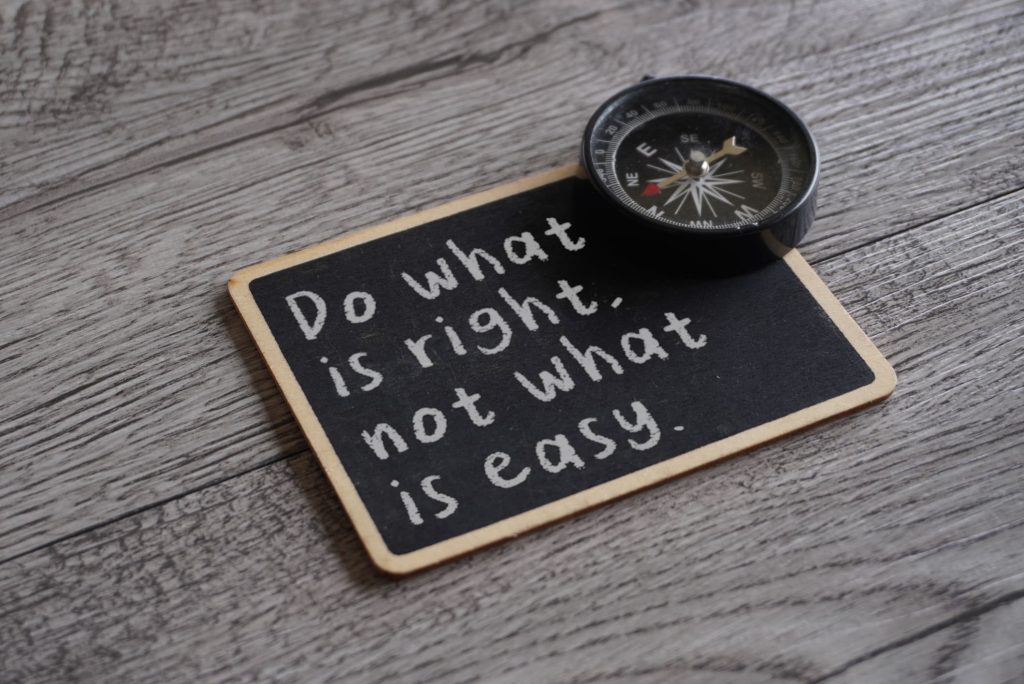
Recently, I was on my way back from the gym and came to a “crossroads”.
I had a choice between crossing a patch of grass about three meters long or turning off onto a paved path, going another 30 meters. I looked at the rutted path through the grass, now just a patch of dry dirt, the result of hundreds of footsteps taking the shortcut. One of my first impulses was to walk the same rutted path. I said to myself, ‘If others have walked this way, what difference will it make if I do? The damage has already been done.”
However, my conscience intervened: “It doesn’t matter how many people have followed this path. You know the right path and it is good to follow it, even if it seems longer and less practical. Who knows, maybe those who see you will follow your example.”
So I chose to bypass and walk the extra 30 meters, avoiding the shortcut.
I felt good, at peace with myself. I immediately thought about the power of example and that every decision, no matter how small, is part of who we are.
In general, when we talk about the power of example, we think of big things: being on time, being respectful, being fair and upright, being an ethical person or caring for the environment. These behaviors are considered “big” because we define our identity and morality through them. They are the pillars we build on to shape our lives and our relationships with others. But is the power of example limited to these major principles or do the ‘minor’ ones matter too?
Who decides which facts are small and which are big? Is there a clear line between big and small when it comes to our personal integrity and values? Aren’t our actions, whether big or small, interconnected and contribute to the full picture of who we are as individuals?
Small everyday gestures may not attract immediate attention, but they gradually help shape our community. Don’t litter, don’t cut in the path of another car, don’t wait at the traffic lights even if no car is passing. Are these not also important gestures in which we express our role as role models?
There is a definition of values that I found profound and revealing: “Values are those things you do when no one is watching.” How true! When you are not being noticed, when there is no external stimulus to encourage you to act in a certain way, your conscience alone dictates your actions.
I remember my time in Copenhagen. On the way home, I was driving on a boulevard that had four lanes in each direction. Three went straight ahead and were almost always clear, and one lane was a right turn lane and there was a long queue of cars for hundreds of meters. However, I didn’t see anyone trying to get in front. Everyone was waiting quietly in line.
You could say it’s a habit shaped by decades of monitoring by the authorities and serious fines when you deviate from the rules. I partially agree. It’s a strictly monitored society, but there is also a strong sense of community and respect for the citizen next to you and it’s visible everywhere you look, on the street, in the parks or at work.
The power of example is not just about great heroic gestures or monumental decisions. It shows its real power in the small, everyday actions, the small behaviors that may seem insignificant, but have a cumulative impact on the world around us. In a society where people are always looking to others to model their behavior, individual example is a powerful message, a way forward.
When we follow our values and choose to do the right thing, even when no one is watching, we create a culture of respect and integrity. Each of us has the power to influence our community by example. Ultimately, our small gestures can create big change. In this way, we can all see ourselves as role models, not just in the big deeds, but also in those moments when we choose to do the right thing, whatever the context.
What minor examples do you give in everyday life?
A day of smiles and fair choices!
Claudiu