
This morning I was listening to Mihai Morar’s podcast with Teodora Mețiu, who was talking about the secret language we have: our voice.
It got me thinking about what Ms. Mețiu said about a quote from a letter by Mark Twain to a friend:
“Forgive me, my dear friend, for writing to you at length, but I didn’t have time to write to you in short!”
Fascinating expression! I had an epiphany!
Over the years, especially in the last 10 years, I have received many testimonials from colleagues, bosses, acquaintances, family or friends about the quality of the presentations I do, especially the PowerPoint ones.
Comments cover both form and content. Concise and to the point, with visual elements that complete a clear picture of the message I want to convey.
Of course I welcome such comments, especially since I put a lot of effort for exactly this reason: to be clear, concise, visual.
Today, however, one thing became clear to me. Why am I looking for the clear message?
A note: In spoken language I don’t always manage to be concise, but in written language I often manage to be clear and to the point. Why?
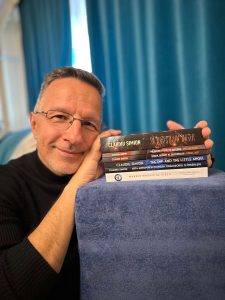
I’m already on my fourth book and writing my fifth. When you write a book of prose, you have the freedom to express yourself at length, as Mark Twain says. I’ve also written two movie scripts.
I’ve done a lot of research in my experience as a “screenwriter.” Anyone who has tried to write a screenplay knows there are a few key elements:
- You have no space! You have a time limit, so you need to say as much with as few words as possible.
- Visuals take precedence over dialog. If you can express something visually, it’s much more impactful than talking.
I’ve intuitively realized that I also intuitively use these writer’s rules when preparing a presentation for an audience, whether it’s 5 people or 500. No one has time for stories, and the attention span, the ability to concentrate, is getting shorter and shorter.
Some thoughts and recommendations from me, following my revelations, especially when it comes to visual presentations (e.g. slides):
- Use as few words as possible. Focus on the key message. If you need to reinforce the idea, fill in verbally what you want to convey. In short!
- Use pictures instead of words. As they say, “A picture is worth 1000 words.” That’s right!
- Use animations and clever transitions only if they clarify the message you want to convey.
- Use the basic rule of communication: say what you are going to say, say what you have to say, recap what you have said. In literary and movie technique there is the term foreshadowing. A loose, but not very accurate, translation would be “foreshadowing/ foreshadowing” and it refers to the technique of suggesting future events or anticipating certain aspects of the story. It is the same in a presentation. Prepare the audience for what’s to come, tell them what it’s about and then draw conclusions.
Do you deliver a concise, complete and short message, spoken or written?
Do you have a clear message?
If you have other ideas, share them.
Have a day of fun and creativity!
Claudiu